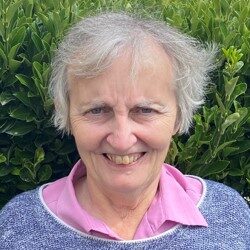
Siobhán Kenny lives in Cork, Ireland. Siobhan’s primary school education was with the Sisters of Mercy. “The Sisters of Mercy have been a part of my life, all of my life”, revealed Siobhan.
 Siobhán is currently the Mission and Values Lead for Mercy University Hospital (MUH) in Cork City which was founded by the Sisters of Mercy in 1857 as a 40-bed hospital. Today, the hospital provides approximately 325 beds and offers a wide range of specialities which provide in-patient, day patient, outpatient and emergency services open 24 hrs. / day and 7 days / week.
“We are located in one of the most socially deprived areas of the country”, stated Siobhán. The people we care for have difficult social and economic means; we have an aging population and a very culturally diverse population.
47 nationalities work in the hospital. This is our new world”.
Siobhán explained the characteristics that differentiate MUH from other hospitals. “The unique point of difference for MUH from the statutory hospitals is the spirit and tradition of Mercy and the tradition, vision and legacy of Catherine McAuley in caring for the marginalised. We work closely with members of the Travelling Community-this would be their hospital of choice due to the respect shown to them; we have a team in the Emergency Department who are leading the way in the treatment of Domestic Violence, and we work very closely with MECPATHS on Human Trafficking. The terminology that I always return to is ‘The awareness of the need and the immediacy of the response’”.
Initially working within a corporate administrative role, Siobhán was appointed Mission and Values Lead in 2018, a brand-new role at MUH.
Siobhán shared how she commenced in her role. “One of the first things I did was to re-energise and reimagine our induction programme for staff, to the Catherine story, understanding Mercy, why we do what we do, how we do it, and how much our values – Respect, Justice, Compassion, Excellence and Team Spirit– underpin everything.
At the heart of MUH are the – aptly named- core values. Describing the origin and significance of the values, Siobhan explained, “The values are taken from the Mercy Constitution. Maria McGuiness rsm led the work with staff from across various disciplines. Staff decided what were core and what they wanted to continue when the Sisters were no longer involved in the day-to- day running of the hospital.”
The values inform the staffs’ behaviours and aspirations and are the hallmarks of excellence by which MUH is to be identified. “The values are practical, you use them in your day-to-day, but they are also empowering you to do better and to live Mercy and to make Mercy real. A huge piece of my role”, emphasised Siobhán, “is ensuring that what we look like, what we do and what we deliver -Mercy- is maintained.”
Programmes, values and behaviours are linked. “A lot of our programmes would be underpinned by our values and there are specific ones that have a values module in them, such as our ‘Engaging with Respect’ programme and ‘Managing People Skills’ programme. We are presently developing a stand-alone programme, based on Staff Engagement and Feedback, focused on aligning behaviours and values and what that will mean and look daily. Staff want this because they want to continue to live the values and to keep embedding them in their departments and they want the confidence to do that.” Recognition of employees in exemplifying the values in their performance is important and is acknowledged by the Employee Choice Values Award.
Siobhán provides a visible and effective mission presence, working with the hospital Boards and Staff to develop the organisational culture of the Hospital“. My big focus is on the critical concerns of Mercy: cultural diversity, care of our common home, social inclusion”.
Siobhán emphasised the importance of collaboration and teamwork in her role. “It’s a stand- alone role but I can’t do anything without the support of the executive management board and the staff. I consider them my team. Thankfully, I have 1500 people who will work with me every day!”
There are many facets to her role Siobhán said, naming several of them. “I’m involved with Induction, Orientation, Training, Education, Pastoral Care and End of Life Care. Then there’s preserving the history and the legacy of the hospital.”
To explain why it is important to her that the legacy is passed on, Siobhán spoke of the Mercy women she has encountered, not just personally, but met in the pages of history, like Sr Raymond Cussen O’Hea who was the Matron of the hospital for 40 years and who gave expression to Catherine’s vision of responding to need. “To have courage, to be brave, to bring forward… there is still a need for a hospital for the sick poor of this city – and many cities across the world.”
“It was always Catherine McAuley’s courage that appealed to me,” continued Siobhán, citing Catherine’s character traits. “She didn’t just accept things. She stood up for injustice. She owned property. She had a great sense of fun. She wrote poetry. She empowered people. We are very fortunate that our leaders are carrying that empowering today for Catherine”.
Siobhán spoke of the gift of mentorship and the contribution that has made to her development. “I have had tremendous mentors from the Sisters, sharing their stories and connecting me to that legacy of Catherine McAuley, that legacy of Mercy, that legacy of going out, walking amongst the people, meeting people where they are and ensuring that they are cared for and that anyone who comes through our door – no matter what their situation in life- is not turned away, but treated with the dignity and respect every person deserves”.
There are other equally valuable life lessons from her time at MUH that have shaped Siobhán. “From the Sisters I learned the power of silence, the power of knowing when your voice is needed and when it isn’t, but being present, listening, especially important in our world today which is very noisy, very opinionated.”
Siobhán channels her passion for Catherine’s vision by nurturing and enabling a community of mercy and justice that will empower and inspire the next generation.
She continued, “I feel very proud that I have been entrusted with that legacy and now I have the job of passing that on to the next generation. This is my part of stewarding the Mercy story but I’m not alone in doing that.”
July 2025 marked 24 years for Siobhán at MUH. “I came to Mercy [hospital] in 2001. It was public service that brought me because it was a patient services role. I’ve remained because there’s a great sense of belonging here; we call ourselves a community of Mercy. People look out for each other, they mind each other. I never feel that I come to work. I’m very fortunate that the work I do is something I’m very passionate about and that is a huge blessing.”
Personal and professional life experiences teach us invaluable lessons. “One of the things I’ve learned working here is that life isn’t black and white”, shared Siobhán. The quote that always comes to mind from Catherine McAuley is to ‘be careful not to make too many laws for if you draw the string too tight it will break ‘. No two people live the same life or tell the same story.
Everyone has their story, everyone has their life. It is that acceptance, that non-judgement. It’s meeting people where they are that I’ve realised is absolutely critical to us all living more harmoniously.
Siobhán prizes among her learnings that from one of her mentors – how the power of words shapes culture. “Very simply she would often say, ‘Sorry and Thank you are very often underused’, so I would be very conscious of always ensuring people are thanked and if a mistake is made, that the word Sorry is used.”
The importance of being flexible, adaptable and open to change have also been significant learnings. “I’ve had a front row seat in key transition periods for this hospital. This gives me confidence in myself and others that people can and will adapt in the right spirit.
“Mercy is who we are and what we are. We are known in Cork as ‘The Mercy’. It’s back to Catherine’s vision. It’s what we were set up to be. We have that wonderful history and legacy and, embracing that pioneering spirit, we continue to move forward, we continue to meet the needs of our population”.
“When I go back through the history books of the hospital, Mercy survived because it adapted and changed and worked and moved with the people and accepted that things change. It will continue to change; how we respond and react to that change is critical”.