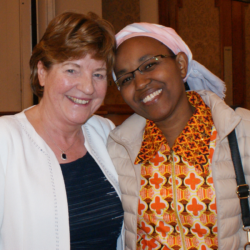
One aspect of my ministry in Dublin involves building bridges between diverse faith communities as a member of the Dublin City Interfaith Forum (DCIF) since 2016. At the beginning of December 2025, members of the Forum, along with a representative from the Northern Ireland Interfaith Forum and a representative from the Irish Council of Churches, among others were invited to visit the European Parliament in Brussels.

European Union flag against Parliament in Brussels, Belgium
Our visit was facilitated by the European Parliament Office in Dublin and the Centre for Religion, Human Values and International Relations in Dublin City University. It was a wonderful experience meeting with Irish MEPs who were showcasing their work, while giving us an opportunity to demonstrate our work at international levels, complementing our ongoing local interfaith dialogue and collaborative projects, like the “InterMu-Se” initiative, which focuses on combating religious hatred.
During our visit, we were invited to attend a meeting on Article 17 of the Treaty on the Functioning of the EU (TFEU), introduced by the Treaty of Lisbon, which provides a legal basis for an open, transparent and regular dialogue between the EU institutions and churches, religious associations, and philosophical and non-confessional organisations.
This article originated in 1994, through an initiative, by Jacques Delors, who was then European Commission President of the EU. He wanted the EU to be more than a political entity at the time, and he aimed to establish formal links between the EU institutions and religious and non-confessional organisations. His aim was to move beyond a purely economic and legal understanding of European integration, to reflect its spiritual and ethical perspectives, and to promote the participation of all strands of civil society in the European integration process –including religious and philosophical organisations.
Mairead McGuinness, when she was First Vice-President of the European Parliament, had responsibility for the Parliament’s dialogue with religious and non-confessional organisations on EU policies and legislative proposals and because of this we were lucky to have a brief meeting with Antonella Sberna, the present Vice-President responsible for the implementation of Article 17. In light of a global scenario filled with rising tensions, increasing complexity and continuous change, Ms Sberna emphasised the importance of creating spaces for discussion and exchange between different perspectives and beliefs. This enables the building of a common understanding on crucial issues for the future of Europe. Like many others, I believe fostering deeper understanding among faith groups, mutual knowledge and peaceful coexistence, will strengthen our democracy, which will create resilient and inclusive communities which contribute to the overall social cohesion of society.
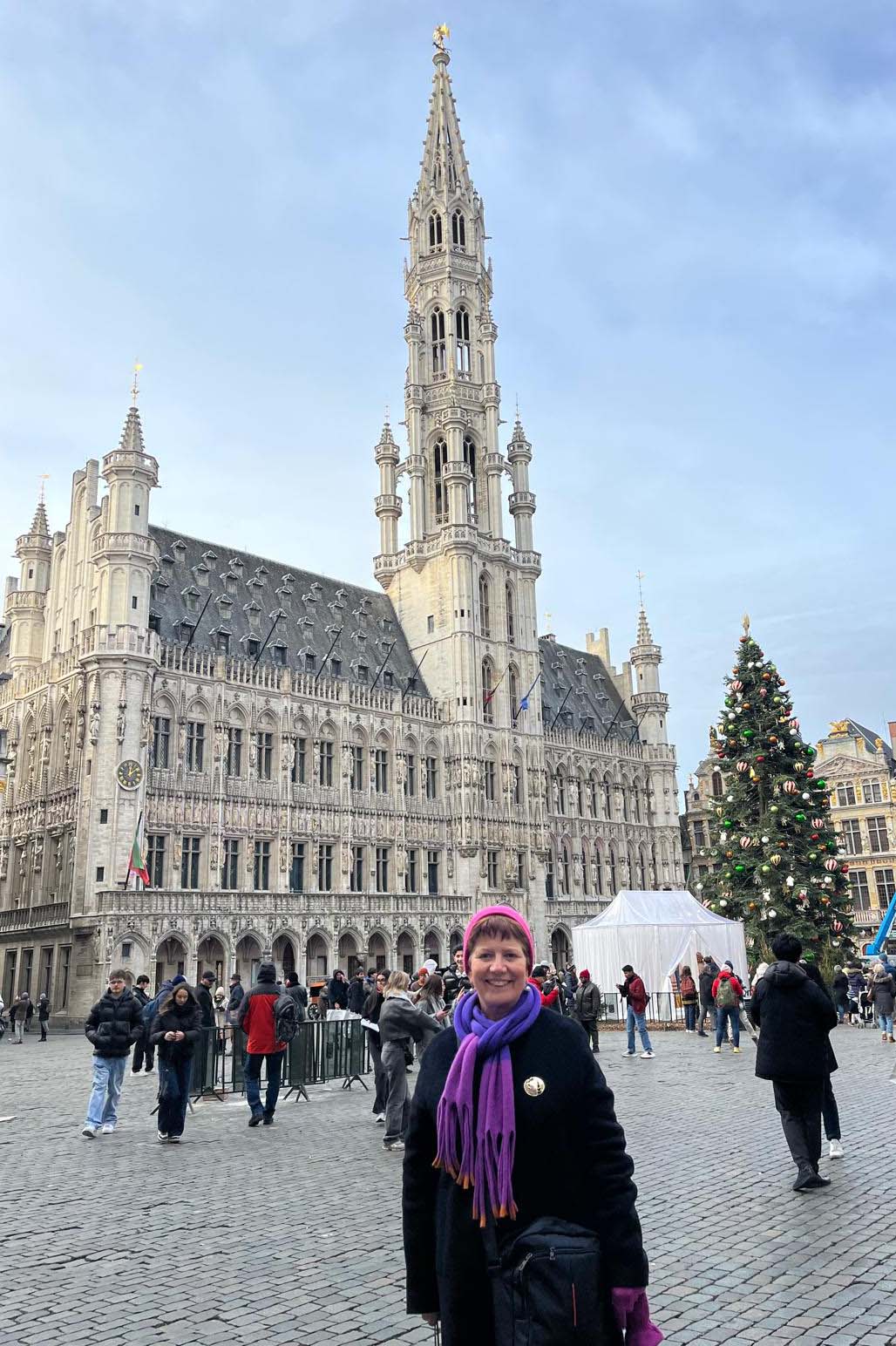
Sheila Curran outside the Cathedral of St. Michael and St. Gudula, Brussels, which will celebrate its 800th anniversary in 2026
On our last day, members of Ireland’s Permanent Representatives in Brussels hosted a lunch for us where we were able to engage in a discussion on the role of faith and philosophical groups in building social cohesion while also and hearing about some of their work and the preparations for Ireland’s Presidency of the EU which begins in July 2026. This will be a very important time for Ireland as Europe faces the ascendency of “right-wing” politics, which mobilises fears around migration, Islam, anti-Semitism and economic precarity. Europe needs to renew its commitment to pluralism, democracy, and transnational solidarity.
The diversity of faith communities has grown in Ireland in recent years. They are a vital part of the social infrastructure. Therefore, it is vital that we foster a society where all faiths are respected and valued, reducing prejudice, and promoting shared values such as peace building, justice, and care for our common home which contribute to an integrated society.
In October 2025, members of DCIF were invited by the Taoiseach Micheál Martin, with leaders from the Christian Churches, Archbishop Eamon Martin and others from philosophical groups, to a meeting to discuss our role in working for social cohesion in a changing Ireland. We in DCIF believe it is vital for Ireland to develop an Interfaith Forum for the whole of Ireland, which would be properly resourced and which would engage regularly with the Taoiseach’s Office. In these challenging times, this would be one way of ensuring that Ireland takes seriously the implementation of Article 17 as a member of the European Parliament. The Taoiseach has said he is open to the possibility and we are now one of the working groups who are engaged in putting a proposal to present to the Taoiseach next year.