Mercy International Association (MIA) has commenced a major programme of Essential Works at Mercy International Centre, 64a Lower Baggot Street, Dublin, the historic first House of Mercy opened by Catherine McAuley on 24 September 1827.
The Essential Works are scheduled from November 2025 to June 2026 and are designed to strengthen the building’s fire safety and structural performance while protecting the integrity and spirit of a building that is a cherished heritage site visited by thousands each year.
Following extensive surveys and design investigations, the project now proceeds with a carefully defined scope that has seen reduced overall costs and ensured a sensitive approach to one of Ireland’s most important heritage buildings. The upgrades will secure the long-term safety, integrity, and mission of Catherine’s House.
For more detailed information on the project see our list of Frequently Asked Questions below:
 Frequently asked Questions:
About the House
Q: What is Mercy International Centre?
A: Mercy International Centre at 64a Lower Baggot Street, Dublin, Ireland is a place of pilgrimage, heritage, and hospitality for Mercy people across the world – an enduring symbol of compassion, service, and community. It is the headquarters of Mercy International Association – an organisation of the leaders of Mercy Congregations, Institutes and Federations throughout the world, founded to serve the Sisters of Mercy, their associates and partners in ministry. Members of the Association share the passion of their foundress, Catherine McAuley, to bring mercy to people who are poor, sick and uneducated.
Q: Why is this building historically significant?
A: Catherine’s House at 64a Lower Baggot Street in Dublin was the first House of Mercy opened by Catherine McAuley on 24 September 1827. It housed the first Mercy Classroom and the first Infirmary. The building was also the original home of the Sisters of Mercy, founded by Catherine McAuley in 1831.
It is an iconic site of Irish religious and social history and at nearly 200 years old, preserves the legacy of Catherine McAuley and continues to welcome pilgrims, researchers, and visitors who seek to connect with the roots of the Mercy story.
About the Essential Works (November 2025 – June 2026)
Q: Why are Essential works being carried out now?
A: As a heritage building, 64a Lower Baggot Street requires upgrades to meet modern fire safety and structural standards. Detailed surveys showed that fire-compartment walls, floors, ceilings, and doors needed significant upgrading to ensure the building remains safe for residents, staff, and visitors.
Q: How long will the works take?
A: The essential work programme runs from November 2025 to June 2026.
The building closed to the public and to all programmes and pilgrimages at the end of September 2025. Staff remained onsite for the month of October 2025 to pack away the house contents and to transfer into secure storage the many precious historical artefacts. The building was handed over to the construction project team in early November 2025.
Q: Who are the project and construction leads?
The fire remediation works project is managed by CBRE (Coldwell Banker Richard Ellis) a global real estate and investment company with a strong presence in Ireland. There are various specialist sub-contractors delivering bespoke aspects of the project including fire certification, electrical, construction and design elements.
Q: What is the overall cost of the project?
A: The Construction works for this phase of the project will be €3,322,000.
Additional related costs including legal, insurance, refurbishment and reinstatement costs will bring the total expenditure to (approximately): €3.6 million.
Q: How will the Essential works and Project Costs be funded?
A: In 1992 Mercy International Association was founded by leaders of Mercy congregations with the primary goal of restoring this historic property which had fallen into disrepair. A global fundraising effort was launched to purchase, restore and maintain the original House of Mercy in Dublin as a heritage centre and spiritual home for the worldwide sisters of Mercy community. An endowment fund was established after the main renovation work was completed in the 1990’s and this fund provides investment income to MIA for ongoing maintenance and running costs of the House.
Most, but not all of the cost of the fire remediation works will be met from interest earned on this fund. In 2025 an Australian congregation coming to completion made a major donation to the project so that the capital of the endowment can remain intact and continue to generate funds for future operations thereby protecting Catherine McAuley’s legacy for future generations. The centre is maintained through donations, programme fees, and investment income.
General Scope of the Works
Q: What is the main focus of the renovation?
A: The project focuses on fire safety by improving compartmentation throughout the building. This includes:
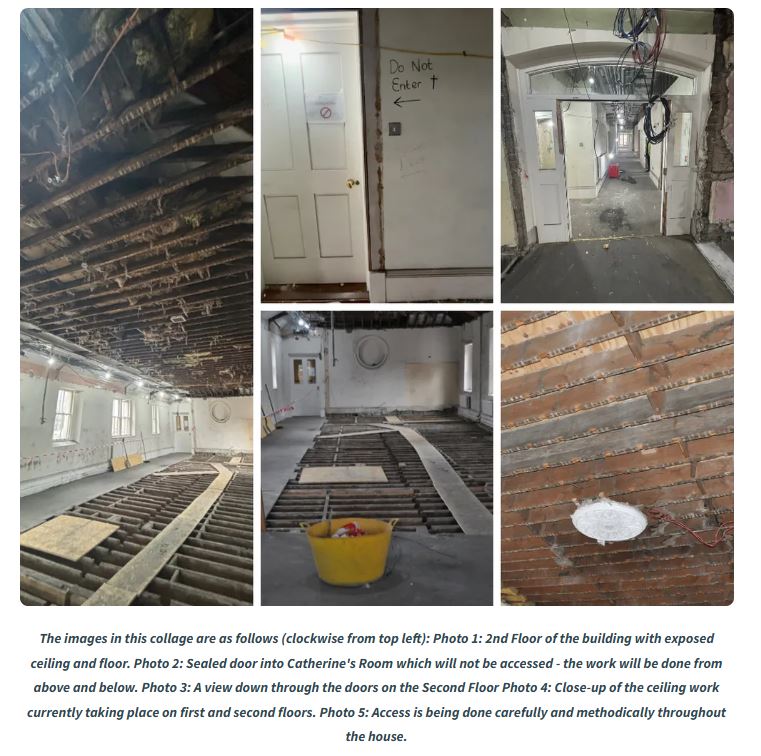
- Carefully removing wall, floor, and ceiling finishes
- Inspecting concealed areas for deficiencies
- Upgrading fire-stopping in ceilings, floors, and walls
- Reinstating finishes to match original character as closely as possible
- Installing certified fire doors on all compartment lines.
Floor-by-Floor Details
Q: What works will be done on the lower ground floor?
- Removal of ceilings where they meet floors and walls above
- Inspection and remediation of deficient fire-stopping
- Upgrading of compartment walls
- Reinstatement of certified fire doors
- Replacement of the screen and door leading to the main stairwell
- Relocation of gift shop to lower ground level with hospitality ministry (tea rooms). Note: The basement of 64a Baggot Street is below ground adjacent to the Grand Canal in Dublin. Therefore, the perimeter retaining wall will not be altered.
Q: What work is planned for the first floor?
- Removal of ceilings where they interface with fire-compartment walls and the floor above
- Inspection of existing conditions and remediation of any deficient fire-stopping
- Upgrading of walls forming fire compartments
- Removal of all doors along fire-compartment lines
- Reinstatement of certified fire doors
- The room where Catherine McAuley was nursed in the final weeks of her life and where she died is not included in the scope and access to it is restricted, ensuring its historical integrity is protected.
Q: What work is planned for the second floor?
- Removal of ceilings to allow full inspection of concealed spaces.
- Remediation of fire-stopping where deficiencies are found.
- Upgrading of any walls forming fire compartments.
- Ensuring all compartment lines continue properly through to the underside of the roof – via the attic – so that compartments are complete.
- Removal and replacement of all fire-compartment-line doors with certified fire doors.
- Reinstatement of proper compartmentation to create a safe means of exit.
- Groundwork to enable future development such as conference facilities, community/volunteer space and self-contained studio accommodation supporting formation/enrichment programmes in the house.
Visitor and Community Information
Q: Will the building remain open during the works?
A: The building and grounds are closed to staff and visitors for the entirety of the project.
Q. Will there be accommodation when the building re-opens?
No. Accommodation on the 2nd floor is not in scope for this phase of the project. The 2nd floor will be developed (as outlined above) at a later date when funds allow. There will not be bed and breakfast accommodation at the House into the future.
Q: Will the heritage of the building be protected?
A: Yes. All interventions are planned with sensitivity to the history and importance of the house for the Mercy world. Finishes will be conserved wherever possible, and replacements will be carefully chosen to reflect the building’s historic character.
Q: Why is so much care being taken with finishes and details?
A: Catherine’s House is not only a historic building – it is a place of memory, meaning, and pilgrimage. Preserving its aesthetic and spiritual atmosphere is essential, even while meeting strict modern fire safety requirements.
Q: What is being done to ensure fire safety during and after the works?
A: The entire project is designed to bring the building to current best practice in fire safety, with upgraded compartment walls, floors, ceilings, and certified fire doors. Throughout the works, safety measures will be closely monitored.
Messages to: Brenda Drumm,
Head of Communications
Mercy International Association